Corfu is an island with a long and varied history. Over the centuries many peoples have passed through, and each has left its mark. That history is felt everywhere, in the old stones, in the narrow lanes and in the land itself. Villa Eremia sits within this setting, near Kassiopi, among scenery that remembers far older times. This article looks first at the island’s past, then at the villa itself, and finally at the historic places you can explore nearby.
Corfu Through the Centuries
Corfu has long been a crossroads of civilisations. Because of its position between East and West, the island often changed hands. The Venetians left the deepest mark. They ruled the island for nearly four centuries, from 1386 to 1797. During that time they built fortified houses, elegant arches and the distinctive stone buildings with red-tiled roofs. The two Venetian fortresses above the old town date from the same period.
After the Venetians came the French for a short while, and then the British. The British ruled the island for half a century, from 1815 to 1864. They introduced neoclassical buildings, colonnades and gardens in the English style. They also left some curious traces, such as the island’s fondness for cricket, which is still played today. This blend of Venetian, British and Greek influence makes Corfu different from the other Greek islands.
The area around Kassiopi has an even older past. According to local tradition, the village takes its name from a temple of Zeus that once stood here. In Roman times the spot was an important harbour. Later, during the Byzantine period, a castle was raised above the bay. It was one of three castles that guarded the island before the Venetians arrived. Today only picturesque ruins remain, but they still remind you how old this corner of the island is.
Villa Eremia and Its Past
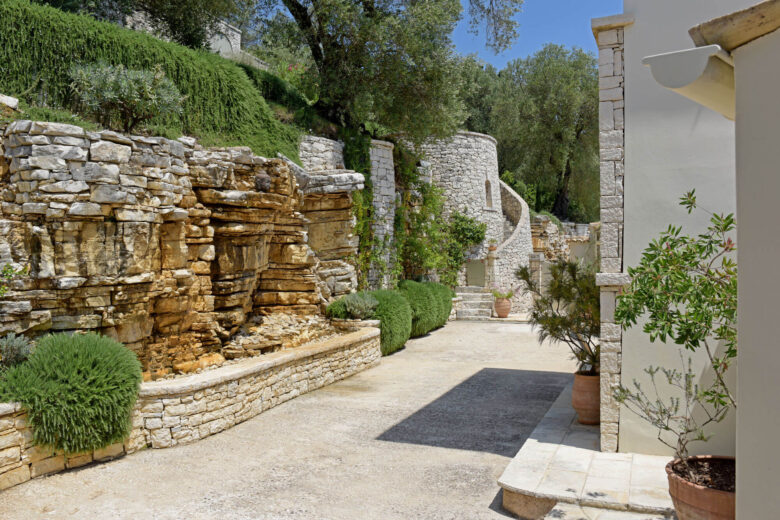
Villa Eremia stands within this historic landscape. The land around it is covered with old olive groves, some of them hundreds of years old. The main building carries the features of traditional Corfiot houses. Its thick stone walls keep the interior cool through the hot summer months. Arched doorways and wooden ceilings show the craft of the local builders. Over the years houses like these were the centre of family life and farm work, including the making of olive oil.
Turning the old house into a place for guests was done with care. The aim was to keep the character of the building rather than erase it. Traditional materials were used throughout, such as local stone, timber from the region and lime plaster. The original stone walls were cleaned and reinforced while keeping their natural surface. The wooden elements were restored wherever it was possible.
Modern comfort was added so that it does not show. The up-to-date heating and cooling, the bathrooms and the kitchen sit behind the old appearance. The interior brings together traditional Corfiot furniture and newer pieces. The colours are drawn from the surrounding nature, in earthy tones, sea blue and white. In this way Villa Eremia offers the comforts of today without losing its link to the past.
The History You Can Explore Nearby
The richest place for history is Corfu Town, about an hour by car from the villa. The old town is a UNESCO World Heritage Site. It is a blend of centuries of Venetian, French and British influence. Along the narrow lanes, known as kantounia, stand tall ochre buildings. Above it all rise the two Venetian fortresses, whose walls give wide views over the sea.
At the heart of the town is the Liston, an elegant arcaded promenade with cafés, built by the French in the style of a street in Paris. Beside it lies the Spianada, the largest square in Greece, where cricket is still played today. Nearby stands the Church of Saint Spyridon, with its tall red bell tower, dedicated to the island’s patron saint. It holds the relics of the saint, which many local people believe to be miraculous.
Closer to the villa is the castle of Kassiopi, only a short distance away. The climb to the ruins is brief, and at the top a view opens over the whole bay. In the village itself is the church of Panagia Kassopitra, built on the foundations of the ancient temple. Together these places tell the island’s story more vividly than any museum.
For guests at Villa Eremia, history is not something to be viewed from a distance. It is part of every day, in the stones of the house and in the landscape around it. From here it is easy to set off towards the old villages, the fortresses and the old town. Getting to know the island’s past is also part of the activities at Villa Eremia, which help guests feel the spirit of this place.