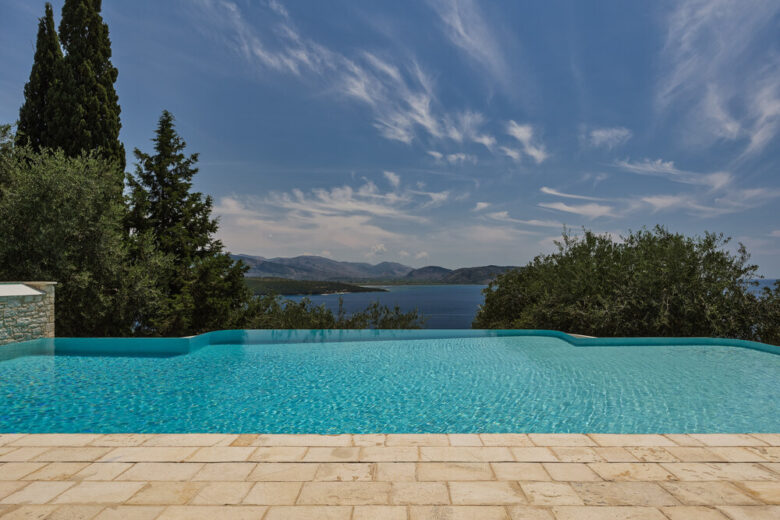
Some parts of Corfu look nothing like the island’s busy resorts. Here the land is still agricultural. The hills roll gently down to the sea, covered in olive groves and cypress trees, with small bays and old villages tucked between them. Villa Eremia sits in exactly this part of the island, on the slopes above the coast near Kassiopi. Guests come for the quiet, but they also find a whole world of nature and places to explore nearby. This article looks first at the land and gardens of the villa, and then at what is worth seeing close by.
The Unspoilt Landscape of Corfu
This part of the island has escaped large-scale development. With no big resort complexes, the night sky here stays dark and full of stars. Mornings begin with birdsong, and evenings close with the sound of cicadas. Many guests say it is this sense of seclusion that makes their stay so restful. The terrain is hilly and creates small pockets of different climate, which support an unusually rich mix of plants and wildlife.
The most striking feature of the landscape is the old olive groves. Some of the trees are hundreds of years old, and their twisted trunks tell of the generations who tended them. Olive growing has been at the heart of life on Corfu since ancient times, and the area still produces good, mild-tasting olive oil.
The hills give the scenery its depth. Every rise opens a new view of the sea. In spring the ground between the olives fills with wildflowers, as red poppies, yellow daisies and wild orchids form a natural carpet. Low stone walls, built without mortar centuries ago, still mark the boundaries of the old plots.
The mild climate supports lush growth. Wild rosemary, thyme and oregano grow across the hills, and their scent is strong in the warm afternoons. Cypress trees stand tall against the sky, while holm oaks give shade and shelter to wildlife. In spring the island’s well-known wild orchids bloom here in dozens of varieties.
The animal life is just as rich. Corfu is an important stop for migrating birds on their way between Europe and Africa, which makes the area a favourite with birdwatchers. Owls call at night, and butterflies are everywhere in the warmer months. Along the stone walls you may spot geckos, and now and then a shy Mediterranean tortoise.
The Gardens of Villa Eremia
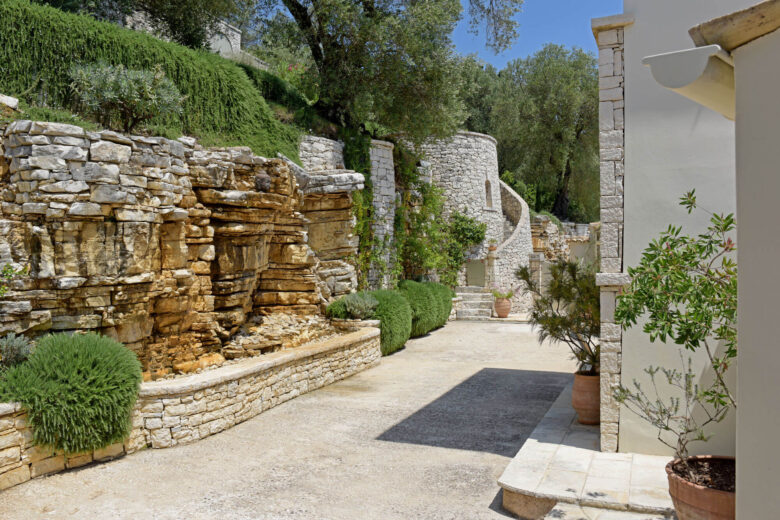
The gardens combine carefully tended areas with natural beauty. They have grown over several generations. Rather than impose a foreign style, those who made them worked with the land and the climate. As a result the gardens feel both cared for and completely at home. What they offer is a green space that gives shade and calm without losing its character.
Corfiot gardens have a long history. Venetians and British both passed through the island, and each left a mark. Water is precious here and is used sparingly, with old stone cisterns collecting rainwater for the dry months. The plants are chosen not only for their beauty but for how well they cope with drought.
Terracing is a defining feature of these gardens. Stone terraces hold the soil on the slope and create different levels. Vines are trained over pergolas for summer shade, and citrus trees, oranges and lemons, grow in small groups, their scent mixing with jasmine. These gardens were never only for looking at. They have always provided food and herbs for everyday use.
Each season brings a different face. Spring is perhaps the brightest, when wisteria drapes the pergolas in cascades of purple, the roses begin their first flush, and wild orchids appear in the grass. The air is fresh after the winter rains.
Summer is a time of abundance. Citrus hangs heavy on the branches, and lavender draws in the bees. The afternoon heat is softened by the shade of tall trees. Autumn brings gentler light and cooler evenings, with the grapes ready to pick. Even winter has a quiet charm, as rosemary and cypress keep their colour and shape, and clear days open up long views.
Nature Beyond the Grounds: What to Explore Nearby
The beauty of this corner does not end at the villa. All around are trails, bays, a mountain and old villages, all within easy reach. It is this mix of seclusion and closeness to interesting places that makes the area so well suited to a quiet holiday.
South of Kassiopi a chain of small bays begins. Old footpaths run between them and are easy to walk. This coast is tied to the Durrell family, whose books about Corfu brought many travellers to the island. In the village of Kalami stands the White House, where the writer Lawrence Durrell lived and wrote. Today its ground floor is a taverna right at the water’s edge.
A little further on is Kouloura, one of the most photographed harbours on the island, with wooden boats and cypress trees. The nearby cove of Agni is known for its three tavernas right on the shore. Boats also leave Kassiopi harbour for bays that are hard to reach by land. Villa Eremia makes a comfortable base for days like these by the sea, and when the group is larger, Elyonas adds extra room alongside it.
Inland the ground climbs towards Pantokrator, the highest mountain on Corfu at close to nine hundred metres. At the summit there is a fourteenth-century monastery and a view in every direction. On a clear day you can see all the way to the coast of Italy.
On the mountain’s slopes lies Old Perithia, the oldest preserved village on the island, about fourteen kilometres from Kassiopi. Its stone houses and old churches give a sense of time standing still. Today there are a few tavernas serving home-style Greek cooking. Half a day is enough to wander the village at an easy pace.
For guests at Villa Eremia, nature is not something to be admired from a distance. It is part of every day. The days follow the natural rhythm of sunrise and sunset. You can pick herbs from the garden, watch birds from the terrace, or set off on foot along one of the trails. The best months for all of this are spring and early autumn, when the weather is warm but not fierce and the crowds are few. That is exactly when Villa Eremia welcomes guests and gives you the chance to slow down in this unspoilt part of the island.